
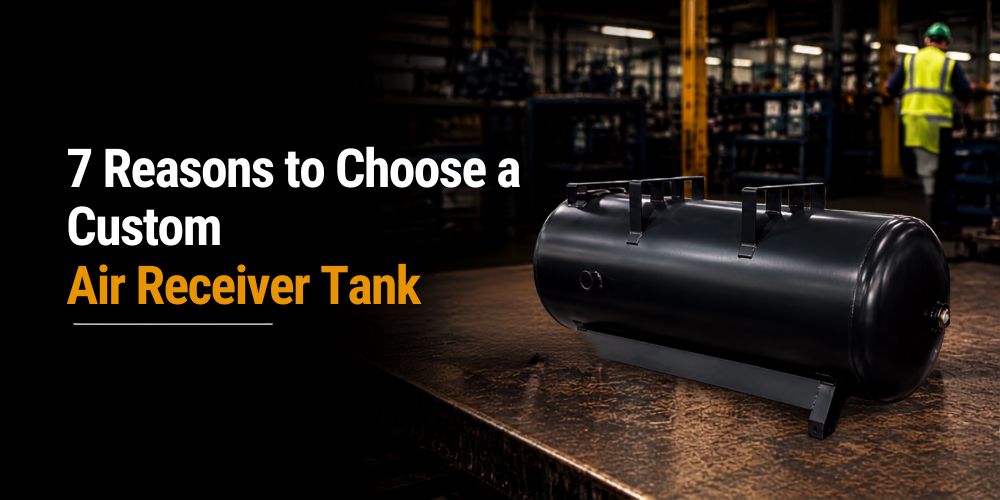
A custom air receiver tank can provide a practical solution for special compressed air applications where standard vessels may not fit the project's requirements. Customization can help address specific air demand, pressure conditions, installation space, nozzle locations, material requirements, and system integration.
A vertical air receiver tank can also be considered where floor space is limited. Before selecting an air receiver manufacturer in India or air receiver tank supplier, businesses should review capacity, pressure, dimensions, materials, connections, safety requirements, testing, and applicable standards.
Hi-Tech Metal Formings (I), an established auto part manufacturer and industrial manufacturing company, can be considered by businesses evaluating experienced Indian manufacturing capabilities for engineered industrial requirements.
One of the main reasons to consider a custom receiver is the ability to match the vessel to the actual compressed air requirement.
Compressed air demand is rarely constant throughout a production facility. Some machines may require a large amount of air for a short period, while other equipment may operate continuously at a lower flow rate.
A correctly sized receiver can provide stored air during short demand peaks and help reduce unnecessary compressor cycling. Industry guidance recommends considering compressor delivery, pressure band, demand duration, and the minimum acceptable pressure when determining receiver size.
This makes a custom industrial air receiver useful for applications where a standard tank may not provide the required storage characteristics.
Factory floors are often occupied by compressors, dryers, piping, production equipment, electrical panels, and other machinery. Finding space for a standard-sized receiver can therefore become difficult.
A custom vessel can be planned around the available installation area. Depending on the application, a vertical air receiver tank can provide useful storage while occupying less floor area.
A vertical air tank can be particularly suitable when floor space is limited but sufficient height is available. The final design should also consider access, foundations, drainage, piping, inspection requirements, and safe maintenance clearance.
Standard receiver tanks generally come with predefined connection arrangements. However, industrial projects may require specific inlet, outlet, drain, pressure gauge, safety valve, or instrumentation positions.
Custom manufacturing allows these connection requirements to be considered during the design stage.
This can make installation easier because the receiver can be planned to suit the existing piping layout rather than requiring unnecessary modifications after delivery.
For large industrial projects, nozzle placement can also affect maintenance access and overall system integration. Customization can therefore help create a more practical installation.
Different compressed air systems operate at different pressure levels. A receiver must be selected according to its required design and operating conditions rather than simply choosing a tank based on volume.
The receiver's allowable working pressure, temperature conditions, safety devices, materials, and applicable design requirements all need to be considered during specification.
A professional air receiver tank manufacturer can review the operating requirements before manufacturing the vessel. This is particularly important when a project involves pressure conditions that differ from common workshop or factory applications.
The safety system should also include appropriate pressure indication and overpressure protection according to the applicable requirements.
The operating environment can influence the material and construction requirements of an air receiver.
For example, a receiver installed in a humid industrial environment may require greater attention to corrosion protection. Other applications may have specific material, coating, or fabrication requirements.
Custom manufacturing provides greater flexibility when specifying material and surface protection according to the application.
The selection should be based on pressure, temperature, environment, corrosion conditions, applicable standards, and the intended service. A qualified air receiver supplier can help review these factors before finalizing the specification.
Some compressed air systems are part of larger production lines or engineered process systems. In such cases, the receiver needs to work with existing compressors, dryers, filters, piping, control systems, and equipment.
A custom air receiver tank can be designed around the overall system rather than considered as an isolated component.
This can be useful for automotive manufacturing, fabrication plants, pneumatic machinery, packaging systems, process equipment, and other industrial applications where compressed air demand changes during production.
For example, a dedicated receiver may be useful for an application that has short but frequent bursts of compressed air demand. The correct receiver size can be determined by studying the demand event and the acceptable pressure drop.
A custom receiver can also be specified with future requirements in mind.
Production facilities may add machinery, increase operating hours, modify their compressed air network, or change production processes. Selecting a receiver only for today's conditions without considering the broader system can create limitations later.
During specification, the project team can consider expected future demand, available installation space, operating pressure, connection requirements, inspection access, and system expansion.
This does not mean choosing the largest possible vessel. Oversizing can also increase capital cost and occupy unnecessary space. The goal is to develop a receiver specification that matches the actual application and expected operating conditions.
Standard air receivers can be an appropriate choice when the required capacity, pressure, dimensions, and connections match readily available configurations.
Custom air receivers become more useful when the project has special requirements such as:
The choice should be based on engineering requirements rather than customization for its own sake.
Selecting the right manufacturer is an important part of a custom pressure-vessel project. An experienced air receiver manufacturer in India should be able to understand the application, review technical requirements, manufacture according to the approved design, and provide the required inspection and documentation.
Hi-Tech Metal Formings (I) is an established Indian manufacturing company and auto part manufacturer with experience in engineered metal products and industrial manufacturing. Its manufacturing background makes it relevant for businesses evaluating experienced manufacturers for industrial fabrication requirements.
When evaluating an air receiver tank supplier, buyers should discuss capacity, pressure, dimensions, orientation, material, connection requirements, application conditions, testing, inspection, and applicable standards before placing an order.
A vertical air receiver tank can be a practical solution when floor space is restricted. Its upright design can provide significant storage capacity without requiring the same floor footprint as some horizontal configurations.
A vertical arrangement may also suit facilities where the plant layout already provides adequate height and where the tank can be properly supported and safely accessed.
However, vertical installation should not be selected only because it saves floor space. Foundation requirements, stability, piping, drain accessibility, inspection access, and local safety requirements should also be reviewed.
Before approaching an air receiver tank supplier, prepare the main technical information required for the project.
This may include:
Providing accurate information allows the manufacturer to evaluate the application more effectively.
A custom air receiver tank can be a practical solution when standard vessels do not match the requirements of a special industrial application. Customization can address air demand, pressure requirements, restricted space, nozzle positioning, material selection, system integration, and future project needs.
The most important step is to select the receiver based on actual system requirements rather than capacity alone. Proper sizing and specification can help the receiver perform its role as a compressed air storage and pressure-buffering component.
For companies searching for an air receiver manufacturer, air receiver supplier, or air receiver tank manufacturer, technical experience and manufacturing capabilities should be considered alongside capacity, pressure rating, quality requirements, inspection, and documentation.
1. What is a custom air receiver tank?
A custom air receiver tank is a pressure vessel manufactured according to specific application requirements. Its capacity, dimensions, orientation, connections, supports, materials, and other features can be planned around the project.
2. When should I choose a custom air receiver instead of a standard tank?
A custom receiver can be considered when a standard tank does not match the required capacity, pressure, dimensions, nozzle arrangement, installation space, material, or system integration requirements.
3. Is a vertical air receiver tank suitable for limited floor space?
A vertical air receiver tank can be useful when floor space is limited and sufficient installation height is available. The complete installation should also consider support, stability, drainage, piping, and maintenance access.
4. How is an air receiver tank sized?
Receiver sizing depends on factors such as compressor output, air demand, pressure range, demand duration, and the minimum acceptable pressure. For dedicated demand events, engineering formulas can be used to determine the required receiver volume.
5. What should I ask an air receiver tank manufacturer?
Ask about the tank's capacity, design and operating pressure, material, dimensions, orientation, nozzle arrangement, safety devices, testing, inspection, applicable standards, documentation, and suitability for your specific application.
6. Can a custom air receiver be integrated into an existing compressed air system?
Yes. A custom receiver can be designed with suitable dimensions, connection points, and orientation to support integration with an existing compressed air network, subject to proper engineering review.
7. Why is choosing the right air receiver supplier important?
An experienced supplier can help ensure that the receiver specification matches the application, installation conditions, operating requirements, and applicable safety and quality requirements.