
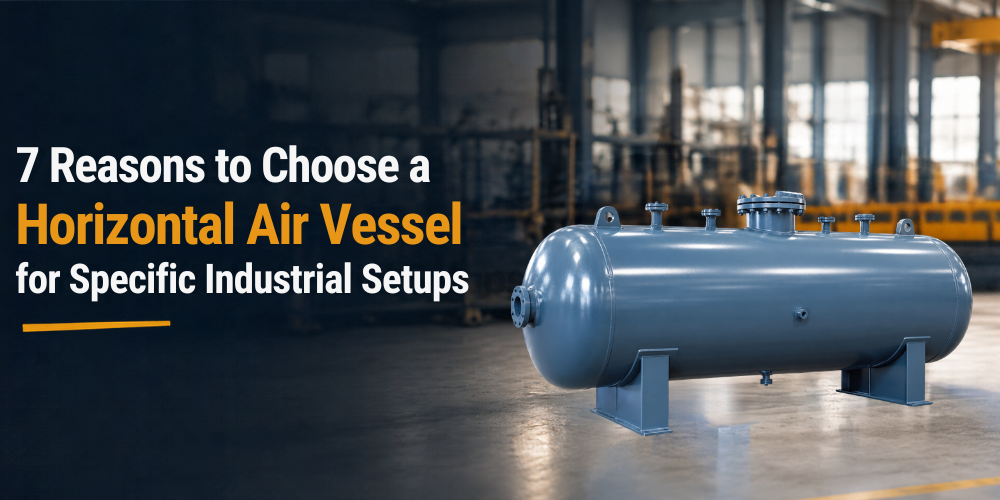
Choosing the right compressed-air storage vessel is an important part of industrial system planning. A horizontal air vessel tank can be a practical option for facilities with limited vertical clearance, suitable floor space, specific equipment layouts, or application-based installation requirements. It can also provide convenient integration with certain compressor arrangements and industrial systems.
However, selection should go beyond comparing air vessel tank price. Pressure, capacity, material, dimensions, safety requirements, maintenance access, and manufacturing quality should all be considered. Working with an experienced air vessel manufacturer such as Hi-Tech Metal Formings (I) can help industries select a configuration suited to their operational and installation needs.
A horizontal air vessel tank is a pressure-rated vessel installed horizontally and used for storing compressed air. It works as a buffer between the compressor and air-consuming equipment, helping maintain a more consistent air supply when demand changes.
Unlike a vertical vessel, the horizontal arrangement extends along the floor rather than upward. This makes it useful for plants where vertical clearance is limited or where the existing layout naturally supports horizontal installation.
The final design should always be selected according to the required pressure, capacity, material, connections, supports, installation conditions, and applicable safety requirements.
One of the biggest reasons to select a horizontal air vessel is limited vertical clearance. Some production areas have overhead structures, pipelines, cranes, ducts, or other equipment that make tall vessels difficult to install.
A horizontal configuration uses more floor length while reducing the overall height requirement. This can make installation easier in facilities where vertical space is restricted.
For plants planning new compressed-air systems or modifying existing ones, this layout advantage can simplify equipment placement.
Every industrial facility has a different layout. Some plants have sufficient floor space but limited height, while others have the opposite arrangement.
A horizontal air vessel can be positioned along an available floor section, making it suitable for particular plant layouts. Its orientation can also be considered alongside compressor placement, piping routes, maintenance access, and other machinery.
This is why an experienced air vessel manufacturer should understand the application instead of supplying a vessel based only on standard dimensions.
The air vessel should work as part of the complete compressed-air system rather than as an isolated component.
Depending on the application, a horizontal configuration can be integrated into a compressor area where equipment is arranged along the same floor level. Certain horizontal receiver designs can also accommodate equipment arrangements that are difficult to achieve with a tall vertical vessel.
Proper planning of inlet, outlet, drain, safety fittings, and piping connections remains essential for safe and efficient operation.
Industrial equipment needs regular inspection and maintenance. The physical orientation of an air vessel can influence how technicians access surrounding components, fittings, valves, drains, and connections.
A horizontal arrangement may provide convenient access in some plant layouts, especially when the vessel is installed at a practical working height with sufficient clearance around it.
However, maintenance convenience depends on the complete installation—not simply whether the vessel is horizontal or vertical. Adequate access should be considered during the planning stage.
Compressed air is widely used in manufacturing environments for pneumatic tools, automation, assembly operations, painting systems, and other production activities. Automotive manufacturing is one example where reliable compressed air can support several processes.
For an automotive facility, the air vessel configuration needs to suit the available installation area and production requirements.
Hi-Tech Metal Formings (I), an established auto part manufacturer, also manufactures air tanks and pressure vessels as part of its industrial manufacturing portfolio. The company has manufacturing experience in automobile sheet metal parts, fabricated assemblies, air tanks, mechanical jacks, pressure vessels, and fire extinguishers.
Industrial projects rarely have exactly the same requirements. The required vessel may differ according to pressure, capacity, dimensions, nozzle arrangement, supports, material, installation conditions, and other technical specifications.
A customized horizontal air vessel tank can therefore be considered when a standard vessel does not fit the available space or system arrangement.
Customization can help manufacturers address specific plant conditions while maintaining the required structural and operational requirements.
An air vessel provides stored compressed air between the compressor and the points of use. This reserve can help manage changing air demand and reduce pressure fluctuations within the system. Air receivers can also support compressor operation by reducing unnecessary cycling when appropriately sized for the application.
The vessel's orientation does not by itself determine system performance. Proper sizing, pressure rating, design, installation, and maintenance are equally important.
Therefore, when comparing a horizontal and vertical option, industries should evaluate the complete compressed-air requirement.
Before selecting a horizontal air vessel tank, consider:
A qualified manufacturer can help match these requirements with a suitable vessel design.
The air vessel tank price can vary significantly from one project to another. It is influenced by factors such as vessel size, material, pressure requirements, dimensions, fabrication complexity, connections, supports, surface treatment, testing, and application-specific requirements.
Therefore, the lowest quoted price may not always represent the best industrial solution. Buyers should compare construction quality, technical specifications, safety requirements, manufacturing experience, and expected service performance along with the initial cost.
Choosing an experienced air vessel manufacturer can help industries obtain a vessel designed around their actual operating requirements rather than simply selecting a standard product.
Hi-Tech Metal Formings (I), based in Indore, has been manufacturing industrial products since 1996. Its portfolio includes automobile sheet metal parts, fabricated assemblies, air tanks, mechanical jacks, pressure vessels, and fire extinguishers. The company operates with certifications including IATF 16949:2016, ISO 14001:2015, and ISO 45001:2018.
Its experience across automotive and industrial manufacturing supports application-focused fabrication for different requirements. For businesses evaluating a horizontal air vessel, technical specifications, installation conditions, and intended application can be considered before finalizing the vessel configuration.
1. What is a horizontal air vessel used for?
A horizontal air vessel is used to store compressed air and provide a buffer between the compressor and air-consuming equipment. It can help support pressure stability and handle variations in air demand.
2. When should I choose a horizontal air vessel tank?
A horizontal vessel can be considered when the installation has limited vertical clearance but sufficient floor space. It may also suit specific compressor-room layouts and equipment arrangements.
3. What factors affect air vessel tank price?
Capacity, pressure rating, material, dimensions, fabrication requirements, connections, supports, testing, and customization can all affect the final air vessel tank price.
4. Is a horizontal air vessel better than a vertical one?
Neither configuration is universally better. The right choice depends on available space, system requirements, compressor arrangement, maintenance access, and installation conditions.
5. Can a horizontal air vessel be customized?
Yes. Industrial air vessels can be designed around specific application requirements such as dimensions, pressure, connections, supports, and installation conditions, subject to applicable design and safety requirements.
6. Where can I find an air vessel manufacturer?
Hi-Tech Metal Formings (I) manufactures air tanks and pressure vessels in Indore and offers industrial manufacturing solutions for application-specific requirements.