
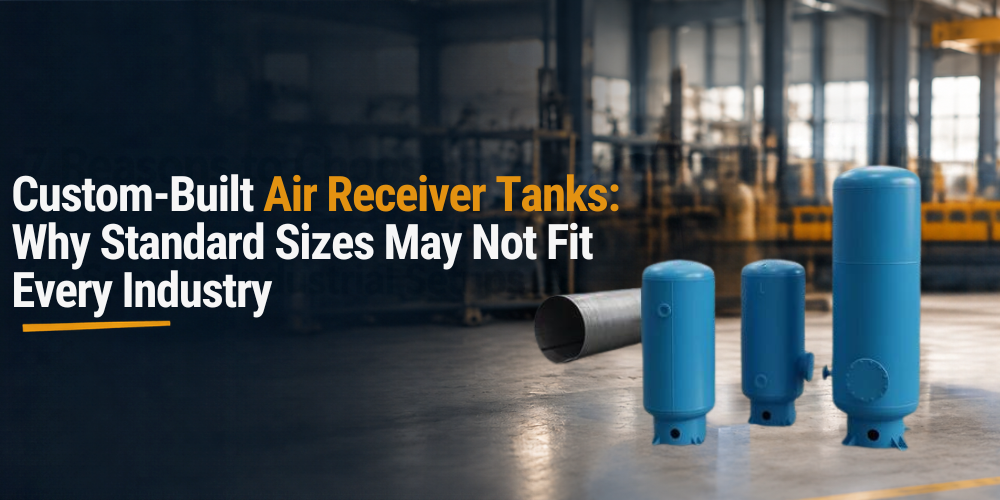
Custom-built air receiver tanks can provide a practical solution when standard sizes do not match an industry's space, pressure, connection, or operating requirements. By considering application-specific dimensions, design specifications, materials, fabrication, and installation arrangements, businesses can select a vessel that integrates more effectively with their compressed-air systems.
However, customisation should be based on genuine technical needs and must follow the applicable engineering and safety standards. Choosing an experienced ,air receiver manufacturer or air receiver tank supplier helps businesses evaluate the right specifications, compare costs, and plan for long-term maintenance.
Hi-Tech Metal Formings (I), an established auto part manufacturer with capabilities in fabricated assemblies, air tanks, and pressure vessels, is relevant when assessing industrial fabrication expertise. Before purchasing, businesses should verify the proposed vessel's specifications, quality requirements, certifications, and suitability for the intended application.
Standard air receiver tanks are manufactured in commonly used capacities and configurations. They can be a practical choice when the available specifications match the application's requirements.
However, industrial facilities differ in their compressor capacity, air consumption, operating pressure, available space, and equipment layout. A standard tank may not offer the exact dimensions, connections, or configuration required for a particular installation.
For example, a facility with limited floor space may need a different vessel arrangement from a plant with a large equipment room. Similarly, a specialised production line may require specific connection locations to integrate with existing piping.
A customised compressed air receiver tank allows these requirements to be considered during the design stage rather than forcing the installation to adapt to an unsuitable standard product.
Different industries use compressed air for different purposes. Manufacturing facilities may operate pneumatic tools, automation equipment, assembly systems, and other air-powered machinery. Each application can have its own demand pattern and operating conditions.
A suitable industrial air receiver must therefore be selected according to the complete system rather than the industry name alone.
Important considerations include:
A qualified air receiver supplier can review these details to determine whether a standard model is suitable or a customised design should be considered.
Available installation space is one of the main reasons businesses consider customised air receiver tanks.
Some industrial facilities have limited floor space, low ceilings, restricted access routes, or existing machinery that limits equipment placement. A standard vessel may be too tall, too wide, or otherwise difficult to install in the available area.
Custom dimensions can help address these physical constraints while maintaining the required engineering and safety provisions.
vertical air receiver tank may be appropriate when floor space is limited and sufficient height is available. In other situations, a horizontal arrangement or a different set of dimensions may suit the installation better.
Before finalising a design, manufacturers should consider the foundation, piping layout, inspection access, drainage arrangements, and maintenance clearance alongside the vessel dimensions.
Not every industrial application operates under the same pressure conditions. The selected air receiver must be designed for the intended working conditions and comply with the applicable pressure-vessel code and regulations.
Customisation can allow a vessel's design specifications to be developed around the actual application. These may include design pressure, operating temperature, material selection, wall thickness, nozzle arrangements, and support requirements.
However, these specifications must be established through appropriate engineering calculations and code requirements. Custom-built does not mean that a vessel can be modified without technical assessment.
A reliable air receiver tank manufacturer should confirm the design basis, relevant testing requirements, and applicable certifications before production begins.
An air receiver tank must connect correctly with the compressor, piping network, and associated air-treatment equipment.
Standard tanks may not always provide the connection sizes, nozzle positions, or drain arrangements required by an existing installation. This can result in additional piping work, installation changes, or difficulties accessing components for maintenance.
A customised design can account for the required inlet and outlet positions, connection specifications, mounting provisions, and drainage arrangements.
For businesses upgrading an existing compressed-air system, sharing technical drawings and connection details with the manufacturer can help identify potential compatibility issues early.
The objective is to ensure that the vessel integrates properly with the system while meeting the applicable design and safety requirements.
Material selection and fabrication quality are important for both standard and customised air receiver tanks. The material must be suitable for the intended pressure, temperature, environment, and design conditions.
Depending on the application, manufacturers may need to consider specific material grades, fabrication processes, welding requirements, surface finishing, and corrosion protection.
Customised manufacturing provides an opportunity to define these requirements according to the project's needs. It does not automatically make a vessel more durable; the final quality depends on appropriate engineering, material control, fabrication, inspection, and maintenance.
When evaluating an air vessel manufacturer in India, ask about material documentation, welding procedures, quality-control practices, testing, and compliance with the relevant design code.
A properly specified customised vessel can help businesses address installation and integration requirements that standard models may not accommodate.
Potential advantages include:
Customisation should be based on a clearly identified requirement. A standard tank remains a sensible choice when it meets the technical specifications, fits the installation, and offers the required compliance.
The decision should consider suitability, total project cost, manufacturing lead time, and long-term maintenance rather than assuming that customised equipment is always the better option.
Before requesting a quotation, prepare the technical information needed to assess the vessel design.
Start by identifying the required storage capacity, working pressure, design conditions, installation dimensions, connection details, and intended application. Include any applicable certification requirements and relevant site drawings.
You should also discuss delivery expectations, surface finishing, inspection documentation, warranty conditions, and maintenance access with the supplier.
The air receiver tank price may vary according to capacity, material, pressure rating, dimensions, design complexity, testing, certification, and finishing. Providing complete specifications makes it easier to compare quotations accurately.
A dependable air receiver supplier should explain which requirements can be accommodated and identify any engineering or compliance considerations that need further review.
The manufacturer's technical and production capabilities are important when evaluating a customised vessel. Look for experience in industrial fabrication, appropriate manufacturing infrastructure, quality-control systems, and the ability to meet the required specifications.
Hi-Tech Metal Formings (I) is an established auto part manufacturer with manufacturing capabilities covering sheet metal components, fabricated assemblies, air tanks, and pressure vessels.
Its industrial manufacturing background is relevant when evaluating fabrication processes, material selection, welding, and production quality. Businesses considering a customised air receiver tank should discuss their capacity, pressure, dimensional, and application requirements with the manufacturer and verify the specific product's capabilities, certifications, and documentation.
Choosing a suitable manufacturing partner can help ensure that the proposed design is evaluated against the actual installation and operating requirements before production begins.
1. What is a custom-built air receiver tank?
A custom-built air receiver tank is a vessel designed around specified requirements such as dimensions, capacity, pressure conditions, connections, and installation configuration, subject to applicable engineering and safety standards.
2. Why might standard air receiver tank sizes not work for my industry?
Standard sizes may not match the available installation space, compressed-air demand, connection arrangement, or operating requirements of a particular facility. Customisation may be appropriate when these differences cannot be addressed with a suitable standard model.
3. Can a vertical air receiver tank be customised?
Depending on the manufacturer's capabilities, a vertical air receiver tank may be designed with application-specific dimensions, connections, and other features. All changes must comply with the applicable engineering and pressure-vessel requirements.
4. Does a customised air receiver tank cost more than a standard model?
It may cost more because of specialised dimensions, engineering, materials, fabrication, testing, or certification. However, the actual cost depends on the complete specification and should be compared with the total cost of adapting a standard tank.
5. How do I choose a reliable air receiver supplier?
Evaluate the supplier's manufacturing capabilities, technical support, quality-control processes, applicable certifications, testing arrangements, documentation, and experience with similar applications.
6. What information is required for a customised air receiver quotation?
Provide the required capacity, working pressure, design conditions, dimensions, connection details, installation layout, intended application, and applicable standards. These details help the manufacturer evaluate the design and prepare a suitable quotation.