
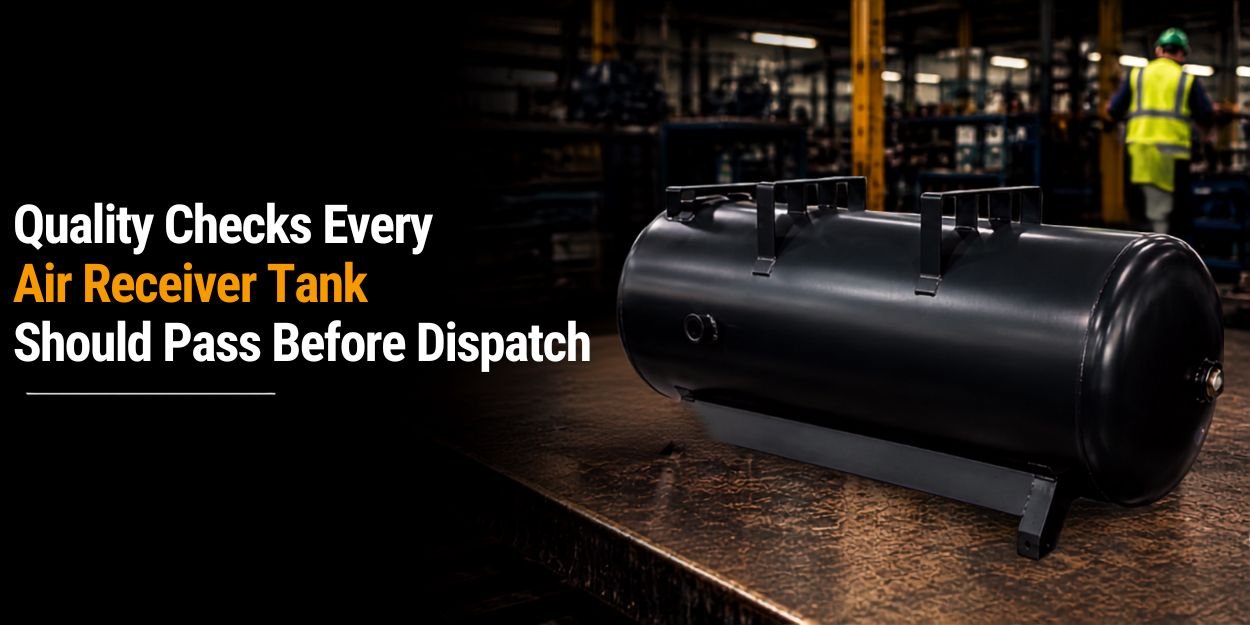
Quality Checks Every Air Receiver Tank Should Pass Before Dispatch
An air receiver tank must pass several quality checks before it reaches the customer. From raw material and dimensional inspection to welding checks, pressure testing, leakage inspection, surface finishing, connection verification, and documentation, each step contributes to the quality of the finished product. Choosing an experienced air receiver tank manufacturer and reliable air receiver tank supplier helps businesses source tanks that are properly fabricated and inspected for their intended application. Hi-Tech Metal Formings (I), an auto part manufacturer with manufacturing expertise, follows a quality-focused approach toward engineered and industrial manufacturing requirements.
Why Quality Inspection Matters for Air Receiver Tanks
An air receiver tank operates under compressed air pressure. Any weakness in fabrication, welding, material selection, or finishing can affect its performance during operation. A proper inspection process helps identify manufacturing defects before the tank reaches the customer. It also helps ensure that the finished product matches the required specifications and application requirements.
For an air receiver tank supplier, delivering a properly inspected product is important for maintaining consistent quality and customer confidence.
1. Raw Material Inspection
Quality checks begin before fabrication starts. The material used to manufacture the tank should be checked against the required specifications.
Important points may include:
- Material grade and thickness
- Material condition
- Dimensions of sheets or plates
- Surface condition
- Material identification and traceability
- Required material certificates
Using the correct material helps the manufacturer maintain consistency throughout the production process. Material inspection also reduces the possibility of manufacturing a tank with unsuitable or inconsistent components.
2. Dimensional Inspection
After fabrication, the dimensions of the air receiver tank are checked carefully.
Inspectors may verify:
- Overall tank dimensions
- Diameter and length
- Nozzle locations
- Opening dimensions
- Support or mounting positions
- Connection sizes
- Alignment of components
Dimensional accuracy is important because the tank may need to fit into a specific compressed air system or installation area. Incorrect dimensions can create difficulties during installation and connection.
3. Welding Quality Inspection
Welding is one of the most important stages in air receiver tank manufacturing. The welded joints need to be inspected for visible defects and proper workmanship.
The inspection can look for issues such as:
- Cracks
- Undercuts
- Porosity
- Incomplete welds
- Surface irregularities
- Improper weld profiles
- Distortion
Depending on the design and applicable requirements, additional non-destructive testing methods may also be considered for selected weld areas.
For an air receiver tank manufacturer, maintaining consistent welding practices is essential because weld quality directly influences the structural integrity of the finished tank.
4. Pressure Testing
Pressure testing is a key quality check for a pressure vessel such as an air receiver tank. The purpose is to verify that the fabricated tank can withstand the specified test conditions without unacceptable leakage or deformation.
A suitable pressure test is carried out according to the applicable design and testing requirements. The tank is monitored during the test for signs of leakage, abnormal deformation, or other concerns.
Pressure testing provides an important verification step before the product is released for dispatch.
5. Leakage Inspection
Leakage can reduce compressed air system efficiency and indicate a fabrication issue. Therefore, connections, welded areas, nozzles, and other relevant points should be inspected for leakage.
The inspection method depends on the design and testing procedure followed by the manufacturer.
A properly inspected tank should not show unacceptable leakage under the specified test conditions.
6. Surface and Finishing Inspection
The external condition of the tank is also checked before dispatch. Surface inspection can identify manufacturing or finishing issues that may affect appearance or subsequent coating performance.
The inspection may cover:
- Surface cleanliness
- Welding finish
- Grinding areas
- Paint or coating condition
- Rust or surface contamination
- Sharp edges
- Overall appearance
Proper surface preparation is particularly important when the tank requires painting or another protective coating as part of its specified finish.
7. Nozzle, Valve and Connection Checks
The connection points of an air receiver tank must be checked against the approved design or customer requirements.
Inspectors may verify the position, size, orientation, and condition of:
- Air inlet and outlet connections
- Drain connection
- Pressure gauge connection
- Safety valve connection
- Inspection openings
- Other specified nozzles
Correct positioning helps ensure that the tank can be installed and connected properly at the customer's facility.
8. Support and Structural Inspection
Air receiver tanks are often supplied with support arrangements such as legs, brackets, saddles, or mounting structures. These components should also be inspected before dispatch.
The inspection can include checking:
- Support dimensions
- Weld quality
- Alignment
- Structural condition
- Mounting hole positions
- Stability of the assembly
A properly fabricated support structure helps the tank remain correctly positioned during installation and operation.
9. Final Visual Inspection
Before dispatch, the complete tank should undergo a final visual inspection. This is the last opportunity to identify visible manufacturing issues before the product leaves the facility.
The final inspection can cover the complete tank, weld areas, nozzles, supports, surface finish, markings, and overall workmanship.
Any identified issue should be reviewed and corrected according to the manufacturer's quality procedure before dispatch.
10. Documentation and Identification Check
Quality inspection does not end with physical testing. Documentation is also an important part of the final release process.
Depending on the project and applicable requirements, documentation may include:
- Material records
- Inspection reports
- Test records
- Product identification details
- Applicable certificates
- Final inspection records
Clear identification and proper documentation help maintain traceability and make it easier for customers to verify the product specifications.
Choosing the Right Air Receiver Tank Supplier
When selecting an air receiver tank supplier, buyers should consider more than product availability. Manufacturing capabilities, inspection procedures, fabrication experience, testing practices, documentation, and consistency should also be considered.
An experienced manufacturer understands that every stage—from material selection and fabrication to testing and final inspection—contributes to the quality of the finished tank.
Hi-Tech Metal Formings (I) brings its manufacturing experience as an auto part manufacturer to industrial fabrication and engineering requirements. A structured quality approach helps ensure that products are checked carefully before they are prepared for dispatch.
Final Thoughts
An air receiver tank should never be dispatched without proper quality verification. Material inspection, dimensional checks, welding inspection, pressure testing, leakage checks, surface inspection, connection verification, structural checks, and final documentation all contribute to reliable manufacturing.
For customers, working with an experienced air receiver tank manufacturer and dependable air receiver tank supplier can make the procurement process easier while ensuring that the product is manufactured and inspected according to the required specifications.